Collaborative Shift Report Management & Automation

Overview

I redesigned our end-of-shift reporting process, replacing an unreliable Slack-based system with a structured, collaborative, and automated reporting workflow.

Previously, shift reports were manually copy-pasted into a group chat by a single staff member at the end of the night. This created gaps in information, no way for others to contribute, and constant notification fatigue across the team. Reports were inconsistent, easy to ignore, and lacked any system for tracking or escalation.

I built a centralized reporting system using Lark that turned shift reports into structured, collaborative records. Staff now submit reports through a guided web form, with the ability for all closing team members to review and edit before finalization. Reports are automatically logged, distributed to relevant teams, and escalated when needed—particularly for maintenance or operational issues.

The result is a system that improves accuracy, reduces noise, and ensures important issues are actually addressed.

Impact

  • Eliminated gaps in reporting by enabling collaborative input across staff
  • Reduced notification fatigue by replacing all-staff messages with targeted distribution
  • Improved response time to maintenance, inventory, and incident issues
  • Increased consistency and completion rates of shift reports
  • Created a searchable database of reports for operational insights and trend tracking

Tools Used

Lark Base · Lark Automations · Lark Messenger

Beyond improving day-to-day operations, the system introduced real accountability and visibility—turning shift reports from a routine task into a reliable operational tool.

Technical Documentation

For a full breakdown of the system design and workflow:
Self-Service Compliance & E-Signature Orchestration

Overview

I replaced a slow, paper-based timecard correction process with a digitized, automated system that improved speed, tracking, and compliance.

Previously, correcting missed clock-ins or clock-outs required physical forms, wet signatures, and manual coordination between staff and managers. If corrections were delayed past tip distribution, the entire tip pool had to be recalculated—requiring every staff member to repay and reauthorize their share. The process was time-consuming, difficult to track, and created potential legal risk.

I designed and implemented a system where staff submit timecard correction requests through a simple online form, pre-authorizing managers to make edits. Submissions are automatically logged, routed to the appropriate manager, and stored as compliant documentation. For more complex cases involving tip redistribution, I built a digital workflow to batch-send repayment authorization forms for e-signature.

The result is a system that reduces delays, improves visibility, and minimizes the likelihood of disruptive tip pool recalculations.

Impact

  • Reduced frequency of full tip pool recalculations to less than once per month
  • Achieved 100% documentation compliance for all timecard adjustments
  • Eliminated need for physical paperwork and manual signature collection
  • Improved visibility into correction status for payroll and management
  • Reduced legal risk through consistent, documented authorization

Tools Used

Lark Base · Lark Forms · Lark Automations · Papersign · Google Drive

Beyond efficiency gains, the system creates a clear, trackable workflow from submission to completion, ensuring payroll accuracy and operational consistency.

Technical Documentation

For a full breakdown of the system architecture, tools, and implementation:

Full-Cycle Automated Onboarding Pipeline

Overview

I designed and implemented a centralized hiring and onboarding system, replacing a fragmented, manual process with a structured, automated workflow.

Previously, hiring was managed through email threads, memory, and inconsistent individual processes. Applications were easy to miss, candidate progress was difficult to track, and approvals often became bottlenecks. Onboarding was equally manual, requiring repetitive communication and follow-up from managers and payroll, which slowed down hiring and occasionally resulted in losing strong candidates.

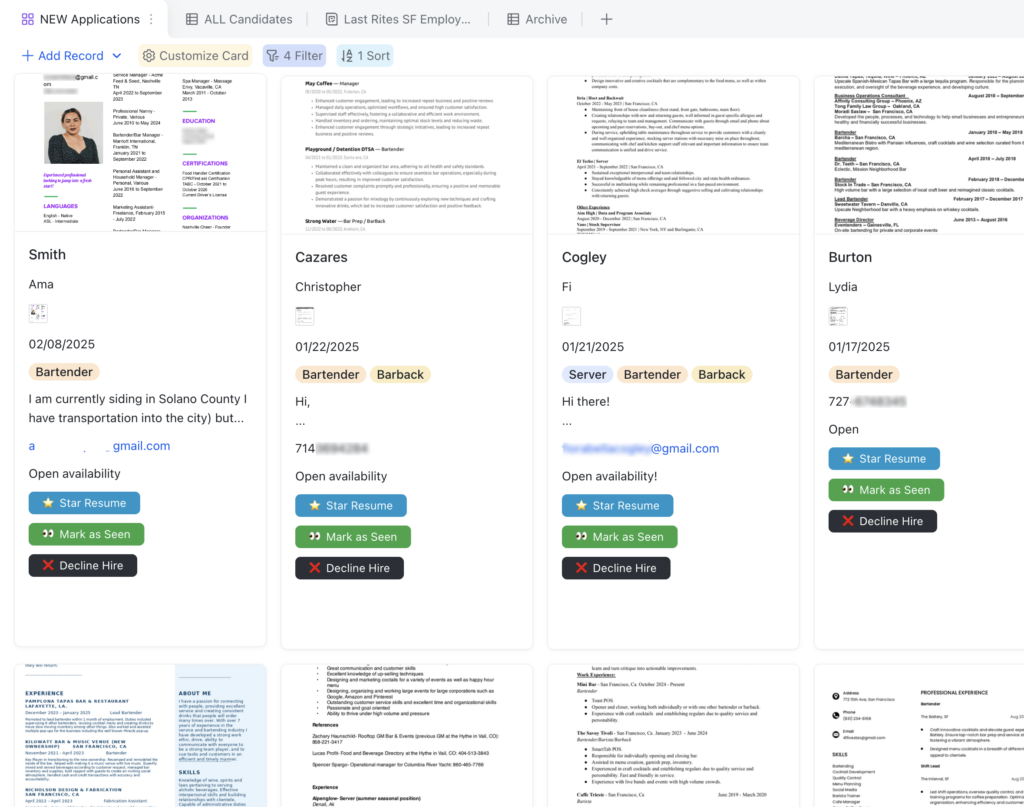
I built a “Hiring Center” using Lark that centralized applicant intake, interview tracking, approvals, and onboarding into a single system. Candidates now apply through a web form, automatically entering a structured pipeline where managers can track progress, leave notes, and move candidates through defined stages. Executive approvals are handled through automated notifications, and once a candidate is hired, onboarding begins immediately through guided workflows that collect required documentation and introduce new hires to company systems.

The result is a system that increases hiring speed, improves visibility, and creates a consistent, scalable process across all locations.

Impact

  • Reduced hiring bottlenecks, particularly during approval stages
  • Eliminated missed candidates and inconsistent follow-ups
  • Improved candidate experience with faster communication and clearer process
  • Increased offer acceptance rates and improved quality of hires
  • Reduced time between offer acceptance and first scheduled shift
  • Centralized visibility for management into hiring pipeline and progress
  • Automated onboarding tasks, reducing manual workload for managers and payroll
  • Standardized hiring across locations, eliminating reliance on individual manager processes

Tools Used

Lark Base · Lark Forms · Lark Automations · Lark Messenger · Lark Wikis · Email

Beyond efficiency gains, the system created a consistent and professional hiring experience—improving both internal operations and the first impression candidates have of the company.

TECHNICAL DOCUMENTATION

For a full breakdown of the system architecture, tools, and implementation:

Player Rating, Ranking & Live Draft Platform

Overview

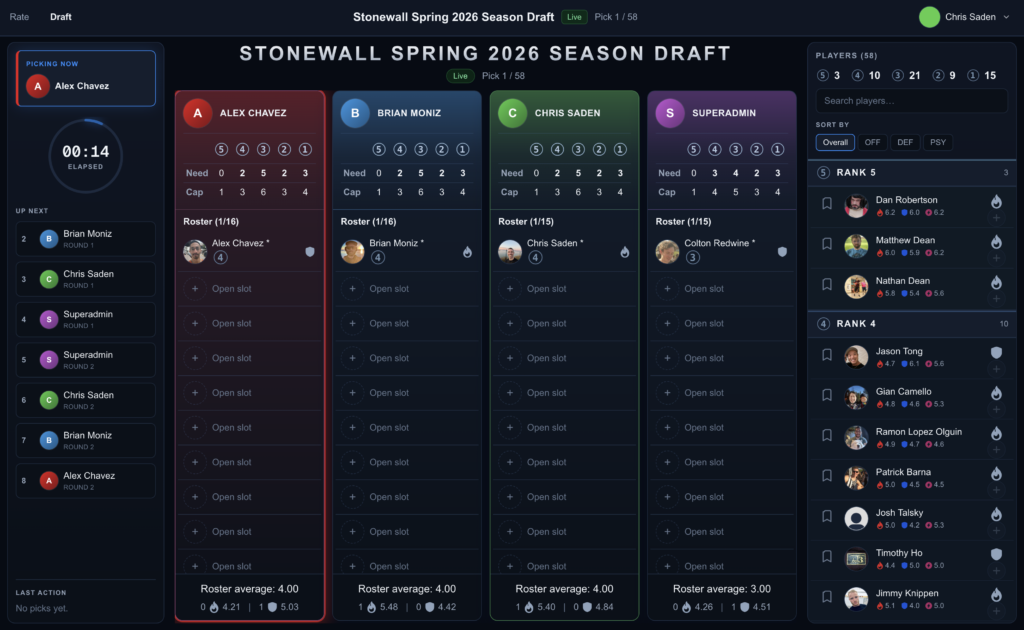
I built the player rating and live draft system for Stonewall Sports from scratch, turning a three-person subjective scoring process into a multi-dimensional, data-driven platform that produces competitive teams and runs in a fraction of the time.

Previously, three board members independently rated each player on a 1–4 scale with no defined criteria, leaving each rater to supply their own interpretation of what the number meant. Scores were averaged and rounded, carrying individual bias directly into draft rankings with no way to reconcile the gaps. Most seasons produced one dominant team, two middling ones, and one that rarely won. Average game score delta sat at 2.9 points, and roughly 20% of players couldn’t be identified by name during the draft itself.

I designed and built the system across two phases. The first used Google Sheets to validate the rating model: six skills across three weighted categories, scored on a 1–7 Likert scale, with Offense and Defense combining into a Base Score and Psych functioning as an exponential multiplier rather than an additive input. Raters worked in siloed tabs with no visibility into each other’s scores. Season 3 migrated to a purpose-built web application, where raters authenticated with bcrypt-hashed credentials, scored players with auto-save and CSV import for returning-player continuity, and admins monitored progress in real time. The live draft interface ran on captains’ phones, with real-time pick updates across all devices, quota-enforced eligibility filtering, and profile photos pulled from linked social accounts.

The result is a system that removes subjectivity from team construction, enforces competitive balance across the entire player pool, and runs a full draft in 15 minutes.

Impact

  • Average game score delta dropped from 2.9 to 1.7 within the first two seasons
  • Draft duration reduced from ~60 minutes to 15 minutes in Season 3
  • Player identification issues dropped from ~20% to 0% after profile photo integration
  • System adopted and run successfully for 3 consecutive seasons
  • Rating data carries forward across seasons via CSV import for returning players

Tools Used

Google Sheets · Next.js · React 19 · TypeScript · PostgreSQL · Prisma ORM · Cursor AI · LeagueApps · Render

Beyond the competitive improvements, the platform is built to grow. New seasons, expanded player pools, or additional sports divisions can be onboarded without rebuilding the core infrastructure.

TECHNICAL DOCUMENTATION

For a full breakdown of the system architecture, tools, and implementation:

Automated Document Router & Infrastructure

Overview

I rebuilt our HR documentation system from the ground up, turning a fragmented, manual process into a centralized, automated, and fully searchable infrastructure.

Previously, employee records were scattered across folders, inconsistently named, and dependent on individual managers to maintain. This created compliance risks, slowed down decision-making, and made even simple document retrieval time-consuming.

I designed and implemented a standardized system across all locations that automated how documents are created, named, and filed. Managers now generate documents through guided web forms, with e-signatures handled automatically and final files routed through a two-stage automation that ensures every document is correctly named, logged, and stored in a predictable structure.

The result is a system that removes guesswork, eliminates duplicates, and makes every employee record instantly accessible.

Impact

  • Reduced documentation time from 5–20 minutes to under 1 minute in many cases
  • Cut document retrieval time from up to 15 minutes to under 30 seconds
  • Reduced manager training from 1–2 hours to ~10–15 minutes
  • Achieved full manager adoption across all locations within 30 days
  • Eliminated reliance on HR for document retrieval

Tools Used

Google Drive · Zapier · Paperform · Papersign · Google Sheets · Lark

Beyond efficiency gains, the system is designed to scale—new document types, tools, or locations can be integrated without rebuilding the workflow.

TECHNICAL DOCUMENTATION

For a full breakdown of the system architecture, tools, and implementation: